


Why Chasing High Dividend Yields Might Be the Wrong Investment Strategy
Investors often seek out dividend-paying stocks for their perceived stability and income generation. But if your strategy is solely focused on chasing high dividend yields, you could be leaving better opportunities on the table—or worse, walking into a financial trap.
In this blog, we’ll explore why relying solely on dividend yield as an investment metric can be misleading. We’ll also look at the differences between yield-focused and growth-oriented investments, using data to demonstrate the long-term implications of both strategies.
The Data: High Dividend Yields vs. Total Returns
The table below, courtesy of YCharts, provides a breakdown of high dividend-yielding stocks and their total returns over various timeframes—1 month, 6 months, 1 year, 5 years, and 10 years.
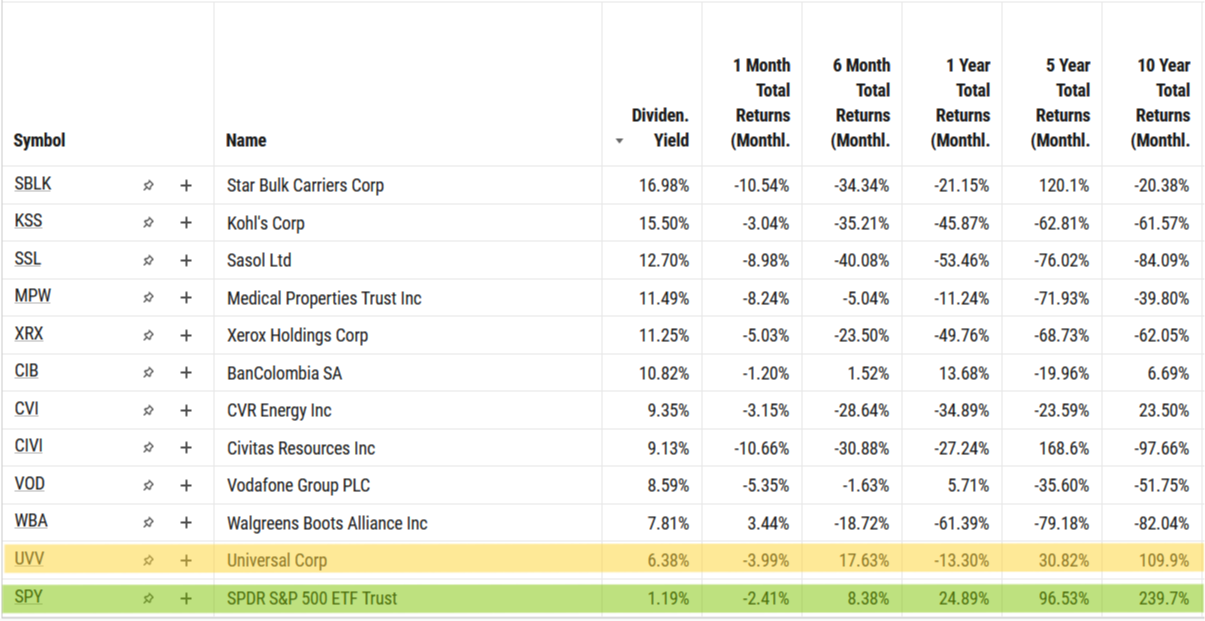
What’s immediately noticeable? Many of these stocks, despite offering high yields, have actually lost value over the last decade.
To be fair, not all high-dividend stocks underperform. Take Universal Corp., for example, which has a current dividend yield of 6.38% and has grown 109% over the past 10 years.
Contrast this with the S&P 500 ETF (SPY). SPY has a much lower dividend yield of 1.19% but delivered a total return of 239% over the same period. This comparison highlights the strength of growth-oriented investments—companies that reinvest in their own growth—over those that focus solely on dividend payouts.
Why Some Companies Pay High Dividends
To understand why a company might pay a high dividend, it’s essential to explore two key concepts:
1. Mature Industries and Limited Growth Opportunities
Companies in mature industries, where growth opportunities are scarce, often turn to dividends to create value for shareholders. These companies generate steady cash flow but lack the ability to reinvest that cash in ways that drive significant growth. Instead, they distribute it as dividends, effectively transferring value to their shareholders.
While this can make sense for income-focused investors, it limits the potential for price appreciation—especially when compared to companies reinvesting in innovation or expansion.
2. Denominator Bias
Dividend yield is calculated by dividing a company’s annual dividend by its stock price. When a stock’s price drops, its dividend yield rises—even if the actual dividend amount hasn’t changed.
This phenomenon, known as denominator bias, can make struggling companies look deceptively attractive. Investors focused solely on yield might buy these stocks without realizing that their fundamentals are deteriorating, increasing the risk of further price declines.
The Risks of Focusing Solely on Dividend Yield
Investing in high-dividend-yield stocks can create several challenges:
Missed Growth Opportunities: Funds that screen for high-yield stocks often exclude innovative, fast-growing companies. These are the businesses reinvesting in R&D, expanding into new markets, and driving long-term price appreciation.
Sector Bias: Dividend-focused funds tend to overweight mature, capital-intensive industries like utilities or consumer staples, potentially leaving investors underexposed to high-growth sectors like technology or healthcare.
Market Volatility: Stocks with high yields can often be more volatile, particularly when dividend cuts occur. This can amplify losses during market downturns.
A Balanced Approach to Investing
Does this mean dividends don’t matter? Not at all. Dividends can play a valuable role in a well-diversified portfolio, particularly for income-focused investors or those nearing retirement.
However, they shouldn’t be the only factor driving your investment decisions. Prioritizing total return—combining price appreciation and dividends—offers a more holistic path to building long-term wealth.
Conclusion: Invest with the Bigger Picture in Mind
While high dividend yields may look appealing on the surface, they can often be a red flag rather than a golden ticket. Understanding why a company pays a dividend—and whether it’s reinvesting in its own growth—is key to making informed investment decisions.
Remember: Investing isn’t just about chasing yields. It’s about building wealth over time through a balanced strategy that focuses on total return.
This blog is for informational purposes only and is not intended as investment advice. Always consult with a financial professional to determine what’s best for your specific situation.